
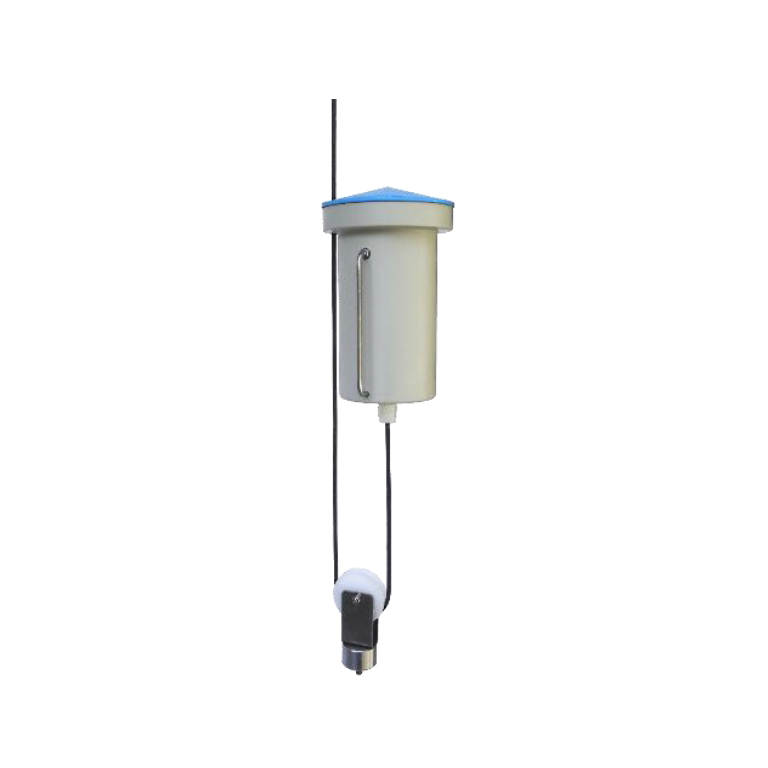
Leakwise ID-225 sensor continuously measures varying layers of hydrocarbons on the surface of the water in many locations where oil leaks accumulate are cleaned. The sensor provides an online trend of oil layer thickness.
Many petroleum and power companies use it for monitoring and control of oil layers in typical applications such as:
On-line monitoring of oil thickness changes over time in groundwater wells, enabling effective oil cleanup by using automated control of remediation.
In many processes, a skim tank is used for collecting wastewater containing oil. The ID-225 may be inserted into a tank through an inspection hatch, enabling automatic start and stop of oil skimming operation.
Environmental regulations require oil/water separator’s effluent monitoring.
An ID-225 can monitor oil layer buildup in the separator without human intervention. When installed before the separator, it indicates when the oil separation capability of the separator is close to maximum and pumping of the thick oil layer should be done.
An ID-225 installed in a sewer near the process area will detect and control big oil leaks at the source, reducing treatment plant load and immediately alarming on big spills.
Leakwise sensors use a high-frequency Electromagnetic Absorption technique. Each floating sensor houses high-frequency electromagnetic energy transmitting and receiving antennas that continuously monitor the liquid surface. Since water absorbs more electromagnetic energy than hydrocarbons, changes in the absorption rate of water indicate the presence or buildup of hydrocarbons.
Leakwise sensors are used for detection and monitoring the buildup of separated or emulsified non-soluble hydrocarbons on water and other aqueous solutions. In addition, the sensors differentiate between a wet and a dry sump. No other oil monitoring system does this.
A Leakwise system consists of a controller and one or more sensors.
The ID-225 sensor has a high-frequency transmitter mounted on a float that maintains its position precisely at the liquid/air interface, despite fluctuations in liquid level up to 45 m (150 ft.) variation, with 30 cm (12. In) minimum water level. Oil layer measurement is already linear at the sensor.
Controller relays are used for local and remote alarms and control, and a 4-20mA output indicates the oil thickness. Continuous built-in diagnostics monitor sensor operation. The SLC-220 digital controller handles up to four sensors. A stilling well is recommended for all ID-225 installations (available as an optional accessory).
SLC-220: Digital Signal Processor for up to four ID-220 Series sensors support, with various output
options, including relays, lights, 4-20 mA, LCD, Modbus in RS-232 and RS-485 communication, and remote cellular connectivity. Controllers – Refer to separate data sheets

Applications Leakwise ID-225 sensor continuously measures varying layers of hydrocarbons on the surface of the water

Applications Leakwise ID-225 sensor continuously measures varying layers of hydrocarbons on the surface of the water

Applications Leakwise ID-225 sensor continuously measures varying layers of hydrocarbons on the surface of the water

Applications Leakwise ID-225 sensor continuously measures varying layers of hydrocarbons on the surface of the water

Applications Leakwise ID-225 sensor continuously measures varying layers of hydrocarbons on the surface of the water